

-17%


Maxmech Surface Water Pump 1HP Stainless Head
Original price was: KSh 12,000.KSh 9,999Current price is: KSh 9,999.
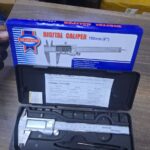
Digital caliper stainless 150mm
Original price was: KSh 3,000.KSh 2,800Current price is: KSh 2,800.
Digital micrometer screw gauge
Original price was: KSh 9,000.KSh 7,500Current price is: KSh 7,500.
- Screw Mechanism: The core of the micrometer is a precisely machined screw. When the thimble (the rotating part) is turned, the spindle moves axially towards or away from the anvil.
- Object Placement: The object to be measured is placed between the anvil and the spindle.
- Ratchet Mechanism: The thimble often has a ratchet stop at its end. This ensures a consistent measuring force is applied to the object, preventing overtightening and ensuring repeatable readings. When the ratchet clicks, it indicates proper contact.
Description
A digital micrometer screw gauge is a precision measuring instrument used to determine the length, diameter, or thickness of objects with very high accuracy. It’s an advanced version of the traditional mechanical micrometer, incorporating digital technology for easier and more precise readings.
Here’s a breakdown of what it is, how it works, its applications, and its pros and cons:
What it is:
- It’s a “C”-shaped instrument with a fixed anvil on one end and a movable spindle on the other.
- Unlike traditional micrometers that rely on reading a vernier scale, digital micrometers feature an LCD screen that displays the measurement directly.
- They can typically achieve accuracies as fine as inches or mm.
How it Works:
Digital micrometers work on the principle of a calibrated screw.
- Screw Mechanism: The core of the micrometer is a precisely machined screw. When the thimble (the rotating part) is turned, the spindle moves axially towards or away from the anvil.
- Object Placement: The object to be measured is placed between the anvil and the spindle.
- Ratchet Mechanism: The thimble often has a ratchet stop at its end. This ensures a consistent measuring force is applied to the object, preventing overtightening and ensuring repeatable readings. When the ratchet clicks, it indicates proper contact.
- Digital Readout: Instead of reading markings on a sleeve and thimble, an internal electronic sensor measures the rotational and axial movement of the screw. This data is then processed and displayed as a numerical value on the LCD screen. Many also have a conventional scale for backup or for those who prefer it.
- Unit Conversion and Zeroing: Digital micrometers usually offer the ability to switch between metric (mm) and imperial (inches) units with a simple button press. They also have a “zero” button to set the display to zero at any point, allowing for relative measurements or compensating for any initial offset.
Additional information
| Weight | 3 kg |
|---|
Reviews (0)
Related products

Original price was: KSh 19,500.KSh 17,000Current price is: KSh 17,000.
Buy via WhatsApp


Original price was: KSh 27,500.KSh 25,000Current price is: KSh 25,000.
Buy via WhatsApp

Original price was: KSh 4,500.KSh 3,500Current price is: KSh 3,500.
Buy via WhatsApp

Original price was: KSh 7,000.KSh 5,500Current price is: KSh 5,500.
Buy via WhatsApp


Original price was: KSh 3,000.KSh 1,999Current price is: KSh 1,999.
Buy via WhatsApp

Original price was: KSh 3,000.KSh 1,800Current price is: KSh 1,800.
Buy via WhatsApp


Original price was: KSh 3,000.KSh 2,650Current price is: KSh 2,650.
Buy via WhatsApp

Original price was: KSh 3,500.KSh 2,500Current price is: KSh 2,500.
Buy via WhatsApp


Original price was: KSh 4,500.KSh 3,500Current price is: KSh 3,500.
Buy via WhatsApp


Original price was: KSh 800.KSh 750Current price is: KSh 750.
Buy via WhatsApp

Original price was: KSh 1,200.KSh 800Current price is: KSh 800.
Buy via WhatsApp

Original price was: KSh 28,000.KSh 24,000Current price is: KSh 24,000.
Buy via WhatsApp
Reviews
There are no reviews yet.